
Podcast Structure: The Complete Guide to Organizing Your Episodes in 2026
Content is the heart of a podcast. But content without clear structure hurts quality. It creates a bad listening experience. A well-structured podcast helps listeners understand your message. It is key to attracting and keeping your audience.
Imagine listening to a podcast. If the structure is messy, it's hard to follow. You might keep listening patiently. But often, you'll just turn it off. A clear structure lets your audience follow your logic. It gives them space to digest information between high and low energy points. More importantly, a unique structure can build your brand's uniqueness. It leaves a lasting impression on listeners.
In short, structure is crucial for podcasts. So, how do you create a podcast with a clear structure? Here are my suggestions.
Understanding Podcast Structure: Why It’s Essential for Audience Growth
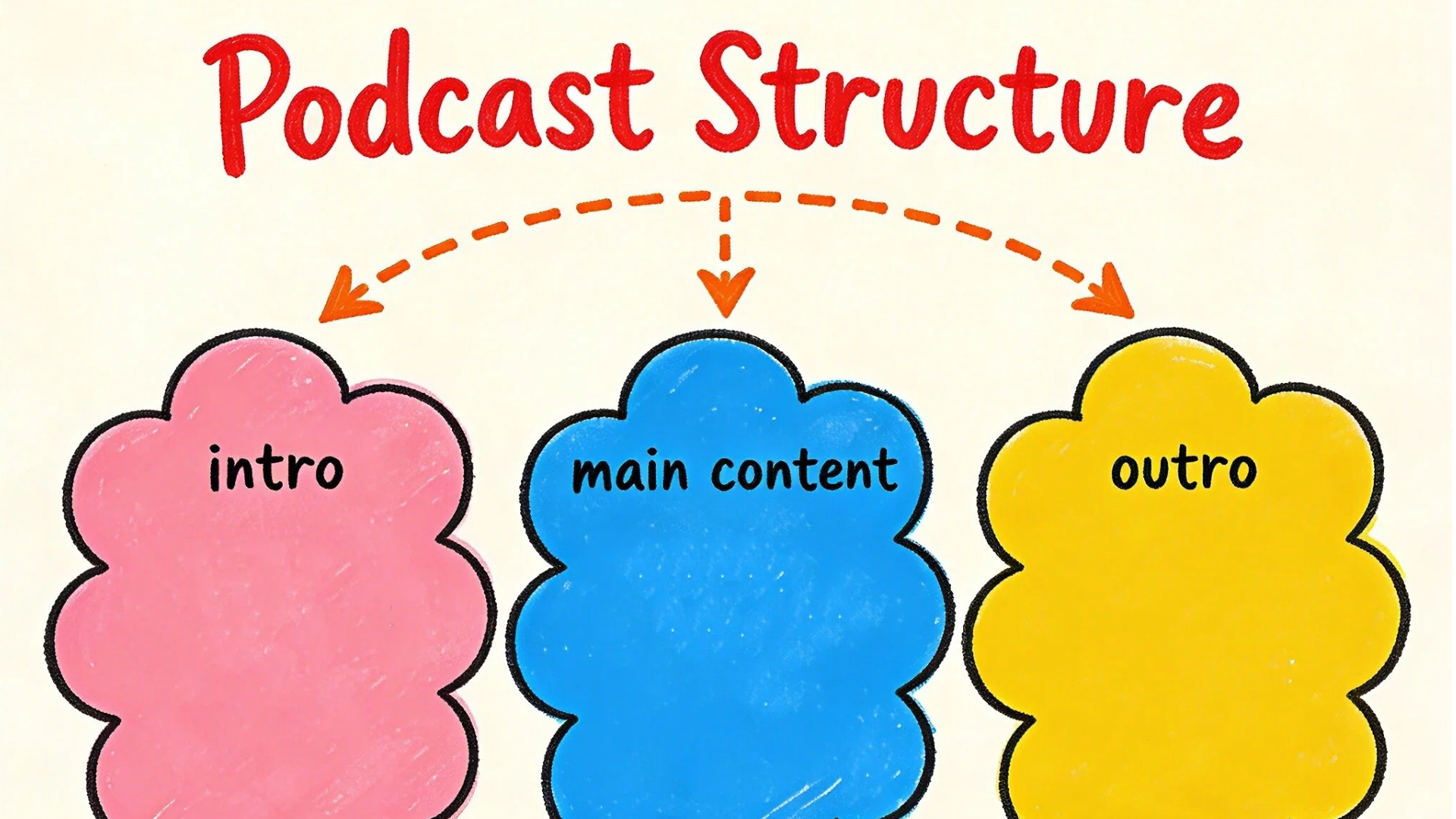
When we talk about "podcast structure," it has three core parts: how to chunk content, how to control pacing, and how to guide listeners.
A clear structure is vital. It directly affects whether listeners stay tuned and how much they remember. Psychologically, a predictable, smooth experience makes listeners more engaged. They are more likely to subscribe and stay.
Core Elements of Podcast Structure
Any podcast episode relies on three core parts. Each has a key mission:
Intro: Set Expectations and Grab Attention
The intro is your "first impression" with listeners. A great intro must do a few things quickly:
- State the topic: Tell listeners what this episode is about. Tell them the value they'll get.
- Create a "hook": Use a question, a surprising fact, or a great audio clip. Grab their curiosity immediately.
- Set the tone: Use your voice and music to show the episode's style. A good intro is like a book's great preface. It makes people eager to keep going.
Main Content: Deliver Value Through Clear Modules
This is the main body of your show. Splitting the main content into clear segments is crucial. For example:
- Problem statement -> Case study -> Solution
- Guest intro -> Core topic discussion -> Rapid-fire Q&A
This modular approach has benefits: - Easier for listeners: Clear logic helps listeners' brains follow along.
- Maintains interest: A new "mini-goal" or content shift every so often fights listener fatigue.
- Shows value: Each module feels like a wrapped gift. Listeners feel they gained something.
Outro: End Strong and Guide Action
The outro is as important as the intro, but often ignored. A strong outro should:
- Summarize and elevate: Briefly recap key points. Or share an emotional quote that resonates.
- Have a clear Call-To-Action (CTA): Honestly ask listeners to do something. Like subscribe, visit your website, or share thoughts on social media. An effective CTA should be specific, simple, and relevant. Successful podcasts often put great care into their outros.
Choosing Your Format and Structural Blueprint
First, know the difference between "format" and "structure." Format is your podcast's type (like interview or solo). Structure is how you organize a single episode. Your format usually sets the basic framework for your structure.
So, start by picking a format that fits your content and goals. This gives your structure a clear starting point to build on.
A Guide to Podcast Formats and Their Structures
Knowing the main formats and their common "scripts" helps you begin. Here’s a breakdown:
Interview Podcasts
A popular format where success depends on smooth, deep conversation.
- Structure: 1) Warm intro of the guest and topic value. 2) Main conversation with questions that go from broad to specific. 3) Wrap-up that summarizes and directs listeners to the guest.
Solo/Monologue Podcasts
Challenging because you carry the whole show. Key is to hold attention.
- Structure: Use clear logic: state your main points upfront, explain them, then summarize. Change pace with stories or pauses. Use fixed segments (like "Tool of the Week") to create rhythm.
Co-hosted/Conversational Podcasts
Fun but can get messy without direction.
- Structure: Start with a clear agenda. Assign roles (e.g., one host leads, one adds humor). Use transition phrases to move between topics smoothly.
Narrative/Storytelling Podcasts
Like an audio documentary, requiring careful editing.
- Structure: Mix scripted narration (to advance the plot) with real audio clips (for impact). Follow a classic story arc: setup, conflict, and resolution, with hooks to keep listeners engaged.
Educational/Instructional Podcasts
Aim is to teach clearly.
- Structure: Start with the learner's goal or problem. Break down the lesson into logical, step-by-step stages. End with a clear summary and action steps.
Branded/Business Podcasts
Goals are brand awareness, authority, or leads.
- Structure: Let business goals guide the format (e.g., interviews for authority, team chats for culture). Weave in brand messages naturally. End with a specific call-to-action tied to a business goal.
How to Choose the Right Format
Pick the "right" format by matching two things:
- Your Audience: Do they want deep interviews or casual chats? Research what's popular in your niche.
- Your Style: Are you a natural solo speaker or a better interviewer? Is your brand formal or friendly? Choose what lets you be authentic.
There's no "best" format, only the "most suitable" one for you, your content, and your listeners. The right choice gives your structure a solid foundation.
Design Your Episode in 4 Steps
With a clear understanding of structure and a format blueprint, the next step is detailed planning for each episode.
Step 1: Define Clear Purpose and Theme for Each Episode
Before each episode, you must answer two key questions. They determine the show's direction and value.
- How to do effective content research and preparation?
First, systematically understand your listeners and topic.- Listener needs: Go to social media groups, comment sections. See what your target audience is discussing, what troubles them. Use tools like AnswerThePublic to find specific questions people ask about a keyword.
- Topic timeliness and depth: Check industry reports, latest research, or news. Ensure your content is both timely and informative. For example, for an episode on "AI writing," combine updates on the latest GPT models with real feedback from writers.
- How to use guest or topic background to add depth?
If you have a guest or specific theme, thorough background work is key to brilliant conversation.- For guests: Deeply research their public work, past interviews. Find unique experiences or perspectives not deeply covered before. This helps you ask amazing questions beyond the usual "How did you succeed?"
- For topics: Map out its history, core debates, and different viewpoints. Become a "temporary expert" on the subject. High-quality interview podcasts, like The Dialog, rely on the host's deep preparation. It makes guests feel respected, leading to more insightful sharing.

Step 2: Break Your Episode into Purposeful Blocks and Segments
After defining the core content, break it into different segments. Design a rhythmic listening journey.
Common segment ideas and their functions: Think of an episode as a performance. It needs different "acts" to vary the mood.
- Opening hook/News update: Grabs attention fast, provides instant value.
- Deep core discussion/Teaching segment: The main body, delivers core value.
- Fun Q&A/Listener mail: Increases interaction and closeness. Makes listeners feel heard.
- Tool recommendation/Fun fact share: Provides a light, practical "bonus."
Use music, sound effects, and transitions to improve flow: The "visual experience" for ears matters.
- Music: A signature intro/outro song builds brand recognition. Soft background music can smooth transitions or set a mood. If you don‘t know how to get the free music, here is our suggestion: Royalty-Free Music for Podcasts: The Ultimate Guide with 18 Top Sites
- Sound effects & transition sounds: A simple ding or swipe sound clearly signals a new segment. It's more natural than a blunt verbal switch ("Okay, next...").
- How-to: In editing software (like Audacity or Descript), create separate tracks for different segments on the timeline. Add consistent transition sounds.

Step 3: Scriptwriting Strategies for Clarity and Authenticity
A script keeps your thoughts clear without turning you into a reading machine.
How detailed your script is depends on your style and content type.
- Word-for-word script: Best for narrative parts, sections needing precise wording, or high-density information. Ensures accuracy and efficiency, but requires practice to avoid sounding like you're reading.
- Detailed outline: Write the core point, key data, transition sentences, and questions for each segment. It provides a framework while allowing improvisation. This is the choice for most conversational shows.
- Bare-bones notes: Just list a few keywords or questions, relying entirely on improvisation. This is the most natural but demands high skill. It can lead to redundancy or tangents.
Many successful hosts mix approaches: Use a word-for-word script for the intro/outro for polish. Use a detailed outline to guide the main conversation.
The key to balancing script and natural conversation is making written words "speakable." Write as you talk. Imagine chatting with a friend. Use short sentences, natural pauses. Mark breaths and emphasis if needed for a more conversational feel when recording. Finally, try to "go off-script." Leave room for spontaneous humor, on-the-spot examples, or natural interaction.
When designing interview questions and segment prompts, remember: Good questions are invitations to share stories, not interrogations.
- Layer your questions: Start with easy, factual questions ("What was the situation then?"). Gradually move to feeling-based ("How did you feel at that moment?") and reflective ones ("How did this change your perspective?").
- Use "prompt phrases" not abrupt switches: Prepare natural transition sentences for segment changes. Like "Speaking of this, I want to ask..." or "That reminds me of another point..."
- Prepare a flexible question list: List your core questions, but adjust the order or dive deeper based on the guest's answers.
If you want more details about script, Here is a guide for you: How to Write a Podcast Script: The Complete Guide with Templates
Step 4: Planning and Maintaining Consistency
The final step: Design episode length and frequency around listener habits and building trust.
There's no absolute rule for ideal episode length, but practice offers guidance.
- Match content and context: Commute times may suit 20-45 minute episodes. Deep interviews or narratives might need 60+ minutes. The key is providing value that matches the length.
- Keep length consistent: If you usually do 30-minute shows, listeners form an expectation. Suddenly doing a 15-minute or 90-minute episode can disrupt their habit. Refer to data reports from major platforms for average lengths by genre. But more importantly, listen to your own audience's feedback.
Maintaining a consistent release schedule is one of the most critical factors for listener loyalty.
- Consistency beats frequency: Whether it's weekly, bi-weekly, or monthly, once you set it, try your best to stick to it. This lets listeners fit your show into their regular routine.
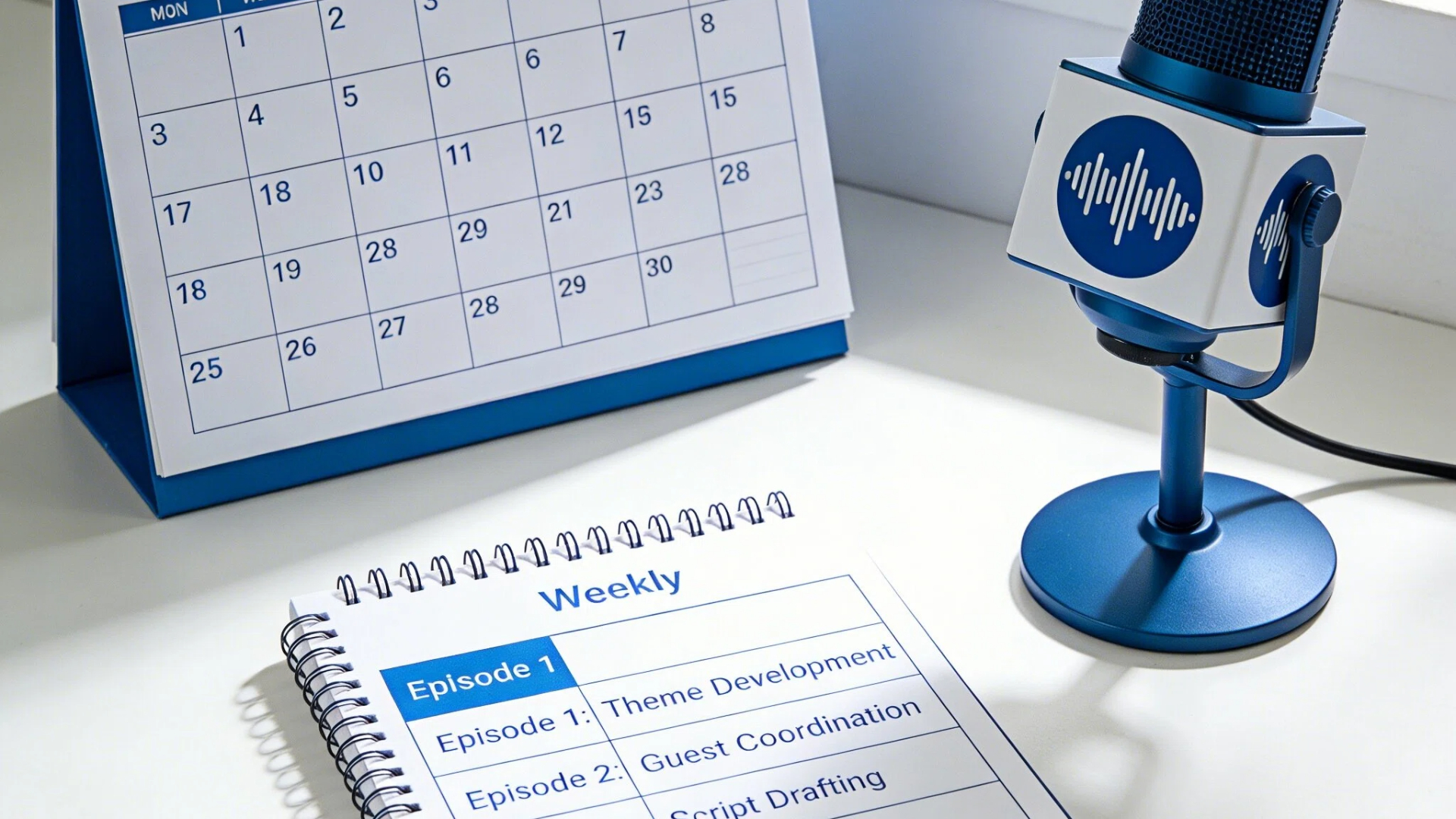
- Create a feasible publishing plan: Use a calendar to backward-plan each episode's timeline (research, record, edit, publish). Leave buffer time for yourself.
- Build a content library: Pre-record several episodes as backup. This handles emergencies and avoids missing a release. Data shows podcasts that can maintain a consistent schedule for over a year see stable, significant growth in subscriptions and listener retention.
Advanced Structuring and Innovation
Once your podcast foundation is solid, you can try some "advanced moves." These innovations can help you stand out, boost appeal, and improve production efficiency.
Incorporating Specialized Segments and Minisodes
Want to add layers and interaction? Try designing special "segments" or releasing short "bonus episodes."
Examples of special segments and their functions: Don't see these as inserts, but as "seasoning" to vary pace and add fun.
- Sponsor ads: A great ad is content itself. Try making it a fixed mini-drama, a sincere recommendation matching your style, or a short "benefits time." Make the ad something listeners look forward to.
- Listener Q&A/Mail: Read listener questions or share their stories on air. Respond sincerely. This instantly builds closeness. Listeners feel part of a community, boosting interaction and belonging. Many podcasts see a significant increase in emails and comments after adding a "listener voice" segment.
- Minisodes: Outside your regular schedule, release short content under 15 minutes. Like a quick answer to a hot topic, a behind-the-scenes peek, or an unaired interview clip. This keeps your channel active and tests new content ideas.
Special segments can improve listener retention. Psychologically, people like predictable "little surprises." When a listener loves a fixed segment in your show (like a weekly "Fun Fact" or "Snarky Review"), they'll come back consistently for that segment.
The Role of Branding in Podcast Structure
Branding is more than a logo and name. It's a complete sensory experience. Your podcast structure is core to building a "sound brand."
Align audio structure with visual branding. Imagine if your show cover is minimalist and modern, but your intro music is loud rock. Listeners would feel confused. True branding means what listeners "hear" and "see" feels consistent.
Your show's tone (serious or humorous), pacing (fast or slow), even sound effect style, should convey the same mood and values as your visual design (cover art, website, social media). For example, a brand podcast focused on meditation and mindfulness often has a calm, spacious audio structure. Visually, it uses serene colors and images. The two are highly aligned.
This increases listener recognition and loyalty. Listeners can instantly identify your show from a fragment in an unfamiliar playlist. They recognize your signature intro, transition music, or the host's catchphrase. This instant recognition creates familiarity and trust. Trust is the foundation of loyalty.
Real-World Examples and Templates
Theory is good, but a ready-made template is better. Here are some concrete examples. You can borrow their frameworks directly.
Interview Podcast Episode Outline & Script Excerpt:
- 【00:00-02:00】Opening Hook: Host spends 30 seconds describing a scene or data related to the guest's achievements. Makes it intriguing. Then introduces the guest: "Helping us solve this mystery today is..."
- 【02:00-10:00】Background & Ice-breaker: Design 2-3 easy questions. Guide the guest to share their origin story or recent updates. Builds rapport.
- 【10:00-30:00】Core Discussion One: Focus on the first theme. Ask 3-4 questions that go deeper layer by layer.
- 【30:00-48:00】Core Discussion Two: Switch to the second theme. Again, go from broad to deep.
- 【48:00-55:00】Rapid-fire Q&A / Fun Segment: Prepare 5-7 short, personalized questions. Changes the pace.
- 【55:00-60:00】Summary & Wrap-up: Host summarizes key takeaways. Clearly tells listeners where to follow the guest. Calls for subscriptions.
- Design Analysis: This structure ensures good pacing, high information density, and provides clear value expectations and action paths for listeners.
Solo Podcast Template (25-minute opinion share example):
- 【0-2 min】Strong Opening: Directly state the core opinion or pose a counter-intuitive question as the hook.
- 【2-5 min】Topic Intro & Roadmap: Briefly explain why the topic matters. Preview the three points you'll cover.
- 【5-10 min】Point One: Present the first sub-point. Support it with a story or case.
- 【10-16 min】Point Two: Present the second sub-point. Explain.
- 【16-22 min】Point Three: Present the third sub-point. Or introduce a deep turn/reflection.
- 【22-25 min】Summary & CTA: Recap the three points. Elevate the theme. Give a specific thought suggestion or action step.
Narrative Podcast Story Arc Example:
- Act 1 (Setup) - Normal Life Disrupted: Use sound to paint an ordinary scene. Then introduce an unexpected event or discovery (e.g., "Until I found that old diary in the attic...").
- Act 2 (Development) - Search & Obstacles: The protagonist tries to find the truth. Encounters a series of setbacks, false leads, or conflicts. End each mini-segment with a bit of suspense.
- Act 3 (Climax & Resolution) - Truth & Aftermath: All clues come together. Reach an emotional and truth-revealing peak. Finally, reveal the event's long-term impact on the protagonist. Leave space for listeners to reflect.

Integrating AI and Automation in Episode Planning and Scripting
AI Tools for Content Ideas & Script Drafting
AI is no longer a distant future. It's a practical partner to boost creative efficiency.
For example, you can use AIPodify to generate episode topics, create question outlines, or even draft an initial script from your bullet points.
The key is to see AI as a draft-assisting tool. It cannot replace your creative core. You must use your own experience and judgment to polish the draft. Add your unique personal style and warmth.
Automation for Structural Consistency & Adaptive Editing
AI is also making waves in post-production.
- Automated Editing: Tools exist to automatically identify and cut silent parts from recordings. Or, based on your set structure template (like "intro," "interview," "outro"), automatically split long audio and add labels. This greatly speeds up rough cutting.
- Personalized Adaptation: In the future, we might see AI that can generate personalized episode versions based on listener preference . Currently, some podcast editing software already includes basic AI noise reduction and equalization features. This lowers the barrier to high-quality post-production.
Conclusion
In summary, a clear, thoughtful structure is key to your podcast's success. It doesn't limit your creativity. Instead, it helps you deliver brilliant ideas to listeners effectively and movingly. Of course, no single template fits all podcasts. You can learn from different techniques and templates. But don't follow them blindly. The most important thing is to adapt and innovate based on your own work.
We've covered a lot of theory above. Now it's time to act. Use these techniques and theories. Add your own fantastic, novel ideas. Experiment boldly. Start creating your podcast blueprint. The world is waiting to hear your voice.

2026 Podcast SEO: The Complete Guide from Basics to Advanced Mastery
According to Infinite Dial 2023 report from Edison Research, over 116 million Americans listen to podcasts every month. That's 41% of people aged 12 and up. The podcast world is growing fast. This means more competition. Many podcasters struggle to get noticed. Listeners can't find them. Old SEO tricks, like stuffing keywords, don't work anymore. New shows pop up all the time. So, how does your podcast stand out? How do you get your amazing content heard by more people? This guide will help. We'll start with the basics. We'll walk you through podcast SEO step by step. Say goodbye to traffic worries.
How to Write Podcast Show Notes for SEO, Listener Engagement, and Growth in 2026
We invest hours in planning, recording, and editing our podcasts, yet the final step of writing show notes often leaves us stuck or exhausted. The result is that many well-produced episodes end up with only a brief description. But you may not realize that such sparse show notes are making your podcast invisible—they hide you from search engines and prevent meaningful engagement and conversions.